
The Birth of a Bureaucratic Fiction
Somewhere in a cramped federal office in 1943, a U.S. Census Bureau clerk made what seemed like a harmless transcription error. While transferring handwritten field reports into official typewritten records, they accidentally created Millerville, Ohio — a fully documented American community that existed only on paper.
 Photo: U.S. Census Bureau, via enclos.com
What should have been a simple correction became a four-decade journey through the labyrinth of federal bureaucracy, proving that sometimes fiction becomes reality through nothing more than persistent paperwork.
The error originated during the 1940 Census follow-up surveys. Field workers had noted several individual farms and households scattered throughout rural Clermont County. When headquarters compiled the data, someone misread the field notes and consolidated these separate properties into what appeared to be a small incorporated town.
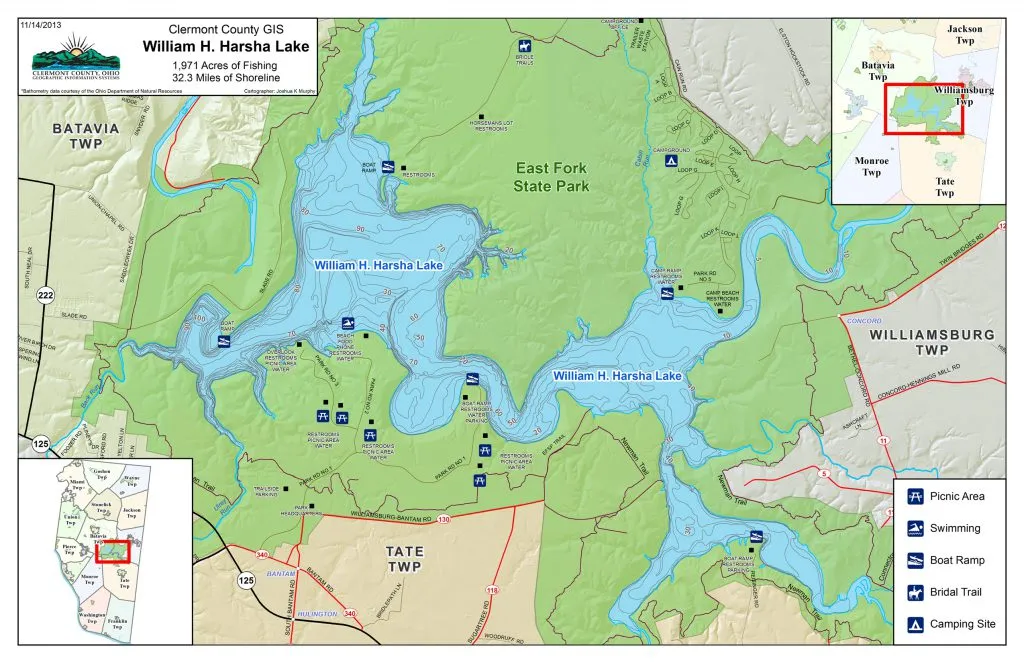 Photo: Clermont County, via gis.clermontcountyohio.gov
Building a Town from Thin Air
Once Millerville entered the federal system, bureaucratic momentum took over. The fictional town received:
- An official population count (47 residents)
- Geographic coordinates (39.0234° N, 84.1456° W)
- A designated postal zone
- Federal tax district assignment
- Inclusion in state economic surveys
- Congressional district allocation
Each government department that referenced the original census data helped solidify Millerville's official existence. The town appeared in federal budgets, state planning documents, and even congressional redistricting maps.
Nobody questioned the data because it looked perfectly legitimate. The population count seemed reasonable for rural Ohio. The coordinates placed it in an appropriately empty-looking area between existing towns. The paperwork bore all the correct federal stamps and reference numbers.
The Phantom Economy
By the 1950s, Millerville had developed a surprisingly detailed bureaucratic identity. Federal agencies assigned the town:
- Agricultural subsidy allocations
- Rural development funding eligibility
- Disaster relief district designation
- Highway planning considerations
- School district boundary references
State agencies began incorporating Millerville into their own records. Ohio's Department of Transportation planned road improvements that would "serve the Millerville community." The state education department allocated rural school funding based partly on Millerville's student population.
Local newspapers occasionally mentioned the town in regional coverage, usually in the context of county-wide statistics or federal funding announcements. Most residents of actual Clermont County had never heard of Millerville, but it kept appearing in official contexts.
The Decade of Invisible Growth
The 1960 Census presented an interesting challenge: how do you count residents of a town that doesn't exist?
Federal field workers assigned to the Millerville area found scattered farms and households, just like their predecessors twenty years earlier. But now they were specifically looking for a town called Millerville. When they couldn't locate the municipal center, they assumed they were dealing with an extremely rural community spread across a wide area.
Their reports described Millerville as "a dispersed rural settlement" with "no traditional downtown area." This explanation satisfied federal reviewers and actually enhanced the town's credibility. Rural Ohio had plenty of communities that existed more as postal addresses than actual population centers.
The 1960 Census officially recorded Millerville's population as 52 residents, showing modest but believable growth over two decades.
When Maps Became Evidence
During the 1970s, computer mapping systems began incorporating decades of federal data into digital databases. Millerville earned its place in early Geographic Information Systems, complete with coordinates, population data, and administrative boundaries.
Cartographers working on state and federal maps found themselves with a dilemma: their databases insisted Millerville existed, but they couldn't find it on any existing maps. Most solved this problem by placing a small dot and text label at the coordinates provided by federal records.
By 1975, Millerville appeared on:
- USGS topographic maps
- State highway atlases
- Federal emergency planning maps
- Congressional district maps
- Tourism and recreation guides
Each map reference reinforced the town's apparent legitimacy. Cartographers assumed previous mapmakers had done proper verification. Previous mapmakers had assumed the federal data was accurate.
The Surveyor's Curiosity
In 1983, Clermont County commissioned a comprehensive land survey to update property records for tax assessment purposes. County surveyor Robert Hayes received the assignment to verify municipal boundaries throughout the region, including the mysterious Millerville.
 Photo: Robert Hayes, via c8.alamy.com
Hayes had lived in Clermont County his entire life and had never heard locals mention Millerville. But federal maps clearly showed the town, and county records referenced it in various administrative contexts.
Armed with precise coordinates and official documentation, Hayes drove to Millerville's supposed location. He found farmland, a few scattered houses, and absolutely no evidence of municipal organization.
The Great Unraveling
Hayes's investigation uncovered the truth within weeks. He traced Millerville's existence back through decades of federal records, discovering the 1943 transcription error that started everything.
The "town" had persisted for forty years through bureaucratic inertia. Each agency that referenced Millerville had assumed someone else had verified its existence. No single office felt responsible for fact-checking data that came with proper federal authentication.
Hayes documented his findings in a report that became legendary among government administrators: "The Case of the Persistent Phantom: How Millerville, Ohio Existed in Federal Records for Four Decades Without Existing in Reality."
The Slow Death of a Paper Town
Removing Millerville from official records proved almost as complicated as its accidental creation. The town had become embedded in dozens of federal and state databases. Each correction required formal documentation, supervisor approval, and cross-reference updates.
The process took three years. Federal agencies had to issue official "municipal status corrections." State departments updated their records. Map publishers printed new editions removing Millerville's dot and label.
By 1986, Millerville had been officially erased from American records. But for four decades, a typing error had maintained a completely fictional town through nothing more than bureaucratic momentum and the assumption that someone else had checked the facts.
Today, the coordinates that once marked Millerville point to a soybean field. The only evidence of the town's "existence" sits in federal archives — thousands of documents proving that sometimes reality is just a matter of proper paperwork.