The Night a Lake Turned Killer
Imagine falling asleep in your village home and never waking up — not from violence, disease, or natural disaster, but because the peaceful lake nearby decided to exhale death. On August 21, 1986, this nightmare became reality for nearly 1,800 people living around Lake Nyos in Cameroon, when one of nature's rarest and most terrifying phenomena turned a quiet night into a mass casualty event that defied explanation.
A Mystery Written in Silence
When rescue teams finally reached the affected villages the next morning, they found a scene that seemed impossible. Bodies lay everywhere — people who had simply collapsed where they stood, with no signs of struggle or injury. Cattle were dead in the fields. Birds had fallen from the sky. Even insects were gone.
But perhaps most unsettling of all, there were survivors: a handful of people who had been on higher ground or in elevated buildings. Their accounts were eerily consistent. Around 9:30 PM, they heard a loud rumbling sound coming from the direction of the lake, followed by what looked like a white fog rolling across the landscape at incredible speed.
Those who got caught in the fog described a smell like gunpowder or rotten eggs, followed by a burning sensation in their eyes and throat. Then they lost consciousness. Those lucky enough to be above the fog watched in horror as it flowed through valleys like a river of death, following the natural contours of the land with terrifying precision.
The Science Behind the Nightmare
What happened at Lake Nyos was something called a limnic eruption — a phenomenon so rare that most people had never heard of it, including many of the scientists who rushed to investigate. Deep volcanic lakes like Nyos can act like giant bottles of soda, with carbon dioxide gas slowly dissolving into the water under pressure.
For centuries, CO2 had been seeping into Lake Nyos from underground volcanic activity, creating layers of gas-saturated water at the bottom of the lake. Like a carbonated drink that's been shaken but not opened, the lake was a disaster waiting to happen. All it needed was the right trigger.
On that August night, something — possibly a landslide, a change in water temperature, or even just the lake reaching a saturation point — caused the gas-heavy water to suddenly rise to the surface. When it hit the lower-pressure environment near the top, the dissolved CO2 came out of solution all at once, creating a massive fountain of deadly gas that shot 300 feet into the air.
The carbon dioxide, being heavier than air, then flowed down the mountainsides like an invisible tsunami, displacing all the oxygen in its path. People and animals didn't die from poisoning — they simply suffocated as the life-sustaining air around them was replaced by pure CO2.
America's Hidden Time Bombs
Here's the part that should keep you up at night: Lake Nyos isn't the only body of water capable of this kind of eruption. Scientists have identified several American lakes that show similar warning signs, particularly in California and Alaska.
Lake Monoun, also in Cameroon, had experienced a smaller limnic eruption just two years before Nyos, killing 37 people. But it took the massive scale of the Nyos disaster to make scientists realize this wasn't just a freak accident — it was a predictable natural phenomenon that could happen anywhere the geological conditions were right.
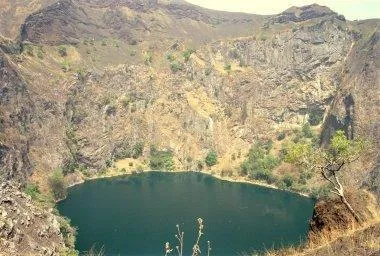 Photo: Lake Monoun, via photos.wikimapia.org
In the United States, researchers have found concerning levels of dissolved CO2 in several volcanic lakes, including some in the Mammoth Lakes area of California. While none are currently at critical levels, the mere possibility has prompted ongoing monitoring and emergency planning.
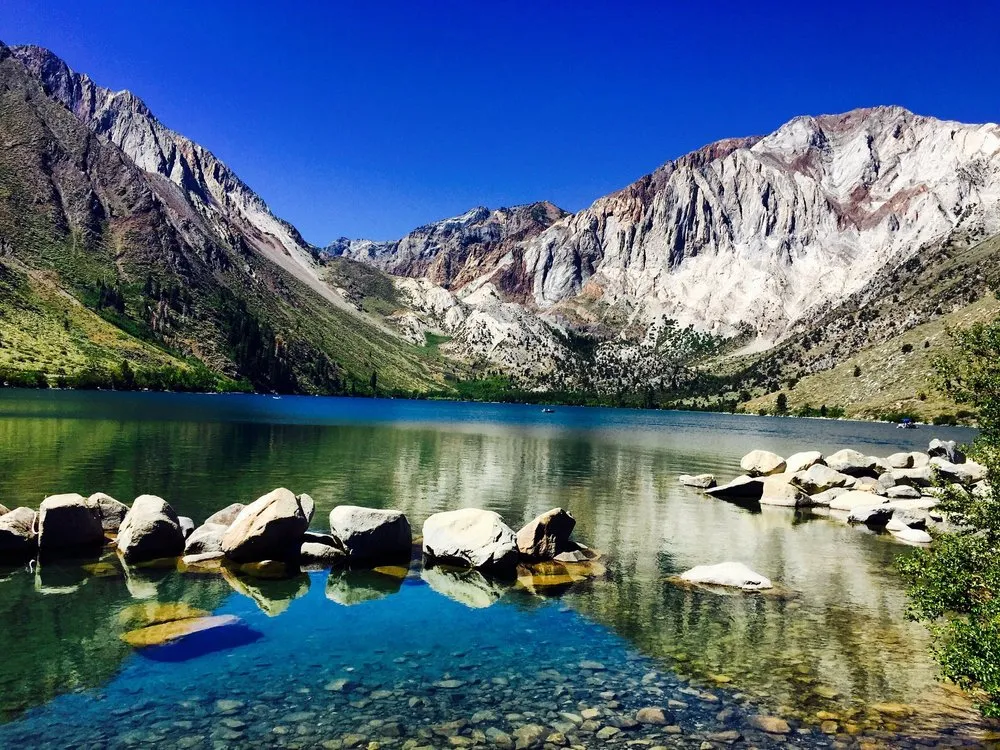 Photo: Mammoth Lakes, via dynamic-media-cdn.tripadvisor.com
The Delicate Solution
The challenge of preventing another Lake Nyos disaster led to one of the most unusual engineering projects in history. Starting in 1995, scientists began installing a system of pipes and pumps designed to slowly vent the gas from the lake's depths, like opening a soda bottle very, very carefully.
The process is delicate and dangerous. Move too fast, and you could trigger exactly the kind of eruption you're trying to prevent. Move too slowly, and the gas continues to build up faster than you can release it. It's like defusing a bomb that's been ticking for centuries, except the bomb is an entire lake and the timer is invisible.
As of 2024, the degassing project has successfully reduced CO2 levels in Lake Nyos by about 30%, but scientists estimate it will take decades to bring the lake to safe levels. Meanwhile, the surrounding communities live with the knowledge that their beautiful lake remains a potential killer.
The Unpredictable Planet We Call Home
The Lake Nyos disaster serves as a stark reminder that our planet is still full of surprises, not all of them pleasant. In an age where we've mapped every corner of the Earth and think we understand natural disasters, limnic eruptions prove that nature still has tricks up her sleeve that can catch us completely off guard.
What makes the phenomenon even more unsettling is its rarity. Unlike earthquakes or hurricanes, which have clear warning signs and established patterns, limnic eruptions can happen with little or no advance notice. The gas builds up silently over decades or centuries, making the lake look perfectly normal until the moment it becomes a weapon.
The survivors of Lake Nyos describe a world that went from peaceful to deadly in a matter of minutes, with no way to predict or prepare for what was coming. It's a sobering reminder that sometimes the most dangerous threats are the ones we never see coming — especially when they're hiding in plain sight, disguised as something as innocent as a mountain lake.
Today, Lake Nyos looks much the same as it did before 1986, its surface calm and blue under the African sun. But beneath that deceptively peaceful exterior, scientists continue their careful work of taming one of nature's most unusual time bombs, one bubble at a time.