The Teenager's Chemistry Blunder That Turned Purple Into Fortune
When Purple Meant Power
Imagine being so catastrophically wrong about a chemistry experiment that you accidentally become a millionaire. That's exactly what happened to William Perkin, an 18-year-old student who was just trying to help cure malaria when he stumbled upon something that would change fashion forever.
In 1856, purple was the color of royalty for good reason — it was impossibly expensive. The only way to get that rich, vibrant hue was from murex shells found in the Mediterranean, and it took thousands of these tiny sea snails to produce just a few ounces of dye. Only emperors and the ultra-wealthy could afford clothes in what we now call "royal purple."
A Bedroom Laboratory Goes Wrong
Perkin wasn't trying to revolutionize fashion. The young chemistry student at London's Royal College was spending his Easter vacation in 1856 working on a problem that had stumped scientists for decades: how to synthesize quinine, the only known treatment for malaria.
Working in a makeshift laboratory in his family's house in East London, Perkin was experimenting with coal tar — the black, sticky byproduct of gas production that most people considered worthless waste. His theory was that he could chemically manipulate compounds found in coal tar to create artificial quinine.
But chemistry rarely goes according to plan, especially when you're 18 and working with equipment that would make modern scientists cringe.
The Beautiful Mistake
After days of failed experiments, Perkin's latest attempt had produced yet another disappointing result: a dark, gunky mess at the bottom of his test tube. Any reasonable person would have cleaned it up and tried again. But Perkin noticed something odd when he tried to wash out the residue with alcohol.
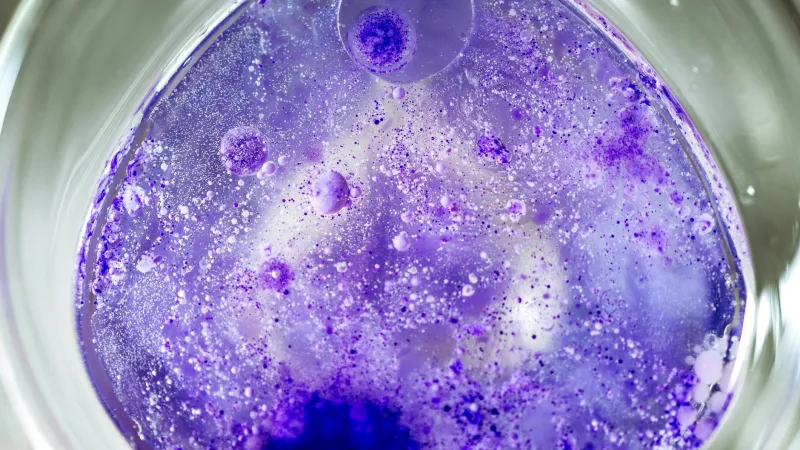
The black sludge dissolved into the most brilliant purple solution he'd ever seen.
Most students would have marveled at the pretty color for a moment and then moved on. Perkin had a different reaction. He dipped a piece of silk into the purple liquid, and when it emerged dyed a gorgeous, even shade of violet that didn't fade when washed, he realized he might have stumbled onto something extraordinary.
From Failure to Fashion Revolution
Perkin had accidentally created the world's first synthetic dye. He called it "mauveine," after the French word for the mallow flower, though it quickly became known as "Perkin's Purple" or simply "mauve."
The timing couldn't have been better. The Industrial Revolution had created a growing middle class hungry for luxury goods that had previously been available only to the aristocracy. Suddenly, anyone could afford to dress like royalty.
The Purple Craze Takes Over
What happened next sounds like something out of a modern marketing playbook, except it was completely organic. Queen Victoria herself appeared in public wearing a mauve gown in 1862, and that royal endorsement triggered what historians call "the mauve mania."
Within months, purple became the must-have color across Europe and America. Women's magazines featured nothing but purple dresses. Men sported purple ties and waistcoats. Even military uniforms incorporated touches of the fashionable hue.
Perkin, still a teenager, found himself at the center of a global phenomenon.
The Accidental Empire
Rather than return to his studies, Perkin convinced his father and older brother to invest in a dye factory. By age 20, he was employing dozens of workers and shipping his synthetic purple around the world.
The success was staggering. What had started as a failed chemistry experiment in a bedroom laboratory became a industrial empire. Perkin's Purple was so profitable that he could afford to retire comfortably by age 36, leaving him free to pursue pure scientific research for the rest of his life.
The Ripple Effect That Changed Everything
Perkin's accidental discovery did more than just democratize purple clothing. It launched the entire synthetic dye industry and, indirectly, laid the groundwork for modern pharmaceutical chemistry. The same techniques used to create artificial colors from coal tar would later be applied to creating synthetic medicines.
Many of the major pharmaceutical companies we know today — including Bayer and BASF — started as dye manufacturers inspired by Perkin's breakthrough.
The Irony of Innovation
Here's the strangest part of the whole story: Perkin never did figure out how to synthesize quinine. That particular puzzle wouldn't be solved until 1944, nearly 90 years later. The malaria treatment he was trying to create remained stubbornly out of reach.
But his "failure" ended up being far more valuable than success would have been. Quinine could save lives, but Perkin's Purple changed how the entire world dressed and sparked a scientific revolution that continues today.
Sometimes the best discoveries happen when we're looking for something else entirely. In Perkin's case, trying to cure a disease led to curing humanity's desire to look fabulous in purple — and that turned out to be pretty valuable too.