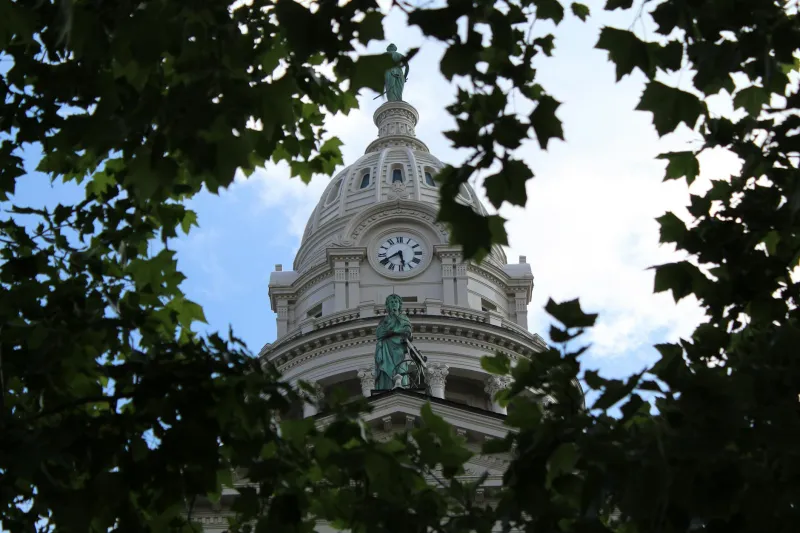
The State That Couldn't Tell Time
Imagine living in a place where crossing the street could put you an hour ahead or behind schedule. For residents of Indiana between 1967 and 2006, this wasn't imagination—it was daily reality. The Hoosier State had turned timekeeping into such a complicated mess that business meetings required careful coordination charts, and TV stations routinely announced showtimes in multiple zones for the same broadcast.
It all started with a simple federal mandate that somehow became a 40-year rebellion against the clock itself.
When Time Became Political
In 1967, Congress passed the Uniform Time Act, requiring most states to observe Daylight Saving Time. While the rest of America dutifully sprang forward and fell back, Indiana decided to chart its own temporal course. The state legislature, citing concerns about farmers and energy costs, opted out of the federal requirement—but only partially.
Here's where things got weird. Indiana sits on the border between Eastern and Central time zones, and different parts of the state chose different approaches to timekeeping. Some counties near Chicago and Louisville—cities that observed Daylight Saving Time—decided to follow suit to maintain business connections. Other counties stuck with standard time year-round.
The result was a patchwork of time zones that shifted not just geographically, but seasonally. During winter months, most of Indiana operated on Eastern Standard Time. But come spring, some counties would "spring forward" while others stayed put, creating a temporal maze that defied logic.
Life in the Time Warp
For Hoosiers, daily life became an exercise in temporal navigation. Business travelers arriving at Indianapolis International Airport needed to confirm not just their destination, but what time zone it would be in when they got there. A drive from Fort Wayne to Terre Haute—about 150 miles—could involve crossing multiple time boundaries depending on the season.
 Photo: Indianapolis International Airport, via europefly.com
Local businesses developed their own coping mechanisms. Radio stations in border areas announced times like "It's 3 o'clock Eastern, 2 o'clock Central, and whatever time you think it is in Indiana." Pizza delivery chains printed special maps showing which time zone each neighborhood followed. Even hospitals had to maintain complex scheduling systems to ensure patient care wasn't compromised by temporal confusion.
The chaos reached peak absurdity during the twice-yearly time changes. While some Indiana counties adjusted their clocks, others remained static, creating situations where neighboring towns operated an hour apart for half the year. Business meetings scheduled between different parts of the state required careful coordination—and even then, people regularly showed up an hour early or late.
The Economics of Confusion
What started as a principled stand against federal overreach quickly became an economic headache. The Indiana Chamber of Commerce estimated that the time zone confusion cost the state millions in lost business opportunities. Companies hesitated to establish operations in areas where something as basic as scheduling a conference call required a geography lesson.
Technology made things worse. Early computer systems struggled to accommodate Indiana's unique temporal situation. Software companies had to create special patches for Indiana users, and online scheduling systems often defaulted to incorrect times for Hoosier zip codes.
The confusion even affected emergency services. Ambulance dispatchers had to verify time zones when coordinating with hospitals in different counties. Police departments near county borders maintained dual clocks to avoid jurisdictional mix-ups.
The Great Time Surrender
By 2005, Indiana's temporal rebellion had become more burden than badge of honor. Governor Mitch Daniels, elected partly on a platform of economic development, identified the time zone chaos as a barrier to business growth. After months of heated debate—including town halls where residents passionately defended their preferred time zones—the legislature finally capitulated.
In 2006, Indiana officially adopted Daylight Saving Time statewide. The decision wasn't universally popular; some counties petitioned to switch time zones entirely rather than observe DST. But for the first time in four decades, the entire state would move its clocks in unison.
Legacy of the Clock Wars
Indiana's time zone rebellion remains one of the strangest examples of state resistance to federal standardization in American history. For 40 years, a basic assumption of modern life—that clocks in the same state would show the same time—simply didn't apply in Indiana.
The episode revealed how something as seemingly simple as timekeeping could become a complex intersection of politics, economics, and regional identity. It also demonstrated the hidden costs of non-conformity in an interconnected world where synchronized schedules had become essential for commerce and communication.
Today, most Hoosiers have adapted to their twice-yearly clock changes. But older residents still remember the days when asking "What time is it?" in Indiana required knowing not just where you were, but which temporal philosophy your particular patch of the state had adopted.