The Crumpled Ball of Foil That Accidentally Launched a Billion-Dollar Industry
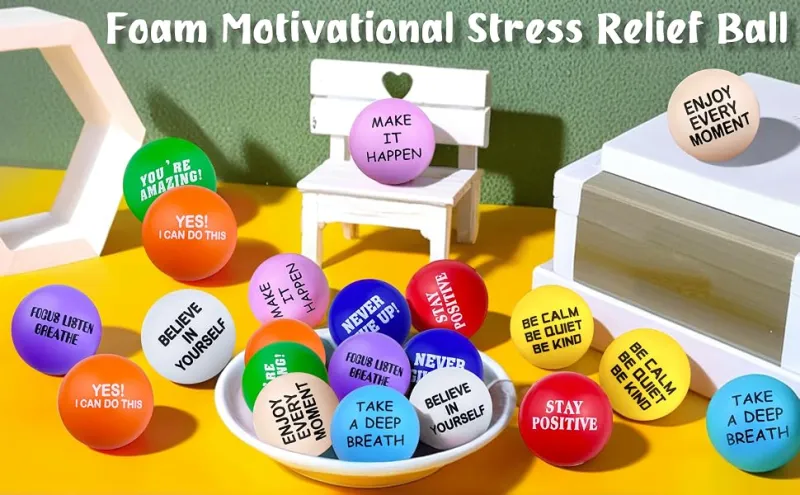
Photo: colorful foam stress balls on office desk, via m.media-amazon.com
Everyone Has One. Nobody Knows Where It Came From.
Right now, somewhere in America, someone is squeezing a stress ball. It's sitting on a desk next to a monitor, or jammed into a gym bag, or being worked methodically by someone on a conference call who would very much like to be somewhere else. They probably got it for free at a trade show. They've never thought about where it came from.
That's actually part of the story.
The stress ball is one of those products so thoroughly absorbed into everyday American life that it seems like it must have always existed — like it was discovered rather than invented, the way you might feel about the paper clip or the rubber band. But it wasn't always there. Someone made the first one. And the story of who that was turns out to be surprisingly contentious, surprisingly funny, and grounded in one of the most relatable moments in modern office history: a person completely losing their composure during a bad phone call.
A Bad Day in a Wilshire Boulevard Office
The year was 1988. The place was a mid-rise office building in Los Angeles, the kind of building that housed the low-glamour machinery of the entertainment industry — agents, managers, publicists, and the various people whose job it was to translate talent into contracts and contracts into money.
 Photo: Wilshire Boulevard, via c8.alamy.com
 Photo: Los Angeles, via i.pinimg.com
A talent agent — accounts vary on his name, and he has never been publicly identified with full certainty — was deep in a phone negotiation that was going nowhere good. At some point during the call, in a gesture of pure frustration, he crumpled up a sheet of aluminum foil that had been sitting on his desk and hurled it at the wall.
It bounced back. He picked it up. He kept squeezing it while the call continued.
This would have been completely unremarkable except for one detail: a product developer named Alex Carswell, who worked for a promotional products company on another floor of the same building, happened to be in the agent's office that day for an unrelated meeting. He watched the whole thing. And something clicked.
Carswell later said the image stuck with him — not the throwing, but the squeezing. The way the agent kept working the foil ball in his hand even after the call ended, almost without realizing it. There was something there, he thought. Something about the physical act of compression as a release valve for tension.
From Foil Ball to Foam Prototype
Carswell didn't rush to a patent office. He went back to his office and started experimenting with materials. Foil was too hard, too loud, too likely to hold its compressed shape. He tried rubber. He tried a gel-filled pouch. He tried dense foam.
The foam worked. It had the right resistance — firm enough to feel satisfying, soft enough to compress fully in one hand, and elastic enough to spring back to its original shape. He had a few rough prototypes made, brought them to a trade show, and the response was immediate. Promotional products buyers understood the concept instinctively. It was cheap to manufacture, easy to brand, and answered a need that nobody had formally identified but everyone apparently had.
Within a few years, foam stress balls — plain, logo-printed, shaped like globes or hearts or little cartoon figures — were everywhere. By the mid-1990s, the promotional products industry was moving tens of millions of them annually. By 2000, the broader stress-relief toy market, which the stress ball had effectively created, was valued at over $300 million.
The Part Where It Gets Complicated
Here's where the story gets thorny: Carswell was not the only person claiming credit.
Around the same time he was developing his foam prototype on the West Coast, at least two other inventors — one in Ohio, one in New York — filed patents for similar squeezable foam objects marketed for stress relief. The Ohio patent, filed in 1987, predated Carswell's timeline and described a foam ball specifically designed for hand exercise and tension reduction. Its inventor argued, with some justification, that the concept was his first.
Carswell's counter was that his product was different in intent and execution — less a therapeutic device than a promotional object — and that the market he built was his own creation regardless of who squeezed foam first.
The legal skirmishes that followed were never fully resolved in any single definitive ruling. Patent law in the promotional products space is notoriously murky, and the stress ball category became a kind of open-source product almost immediately — too cheap, too simple, and too widely copied for any single party to lock down.
What nobody disputes is that the category exploded, and that it did so largely because the promotional industry got behind it in a way that no individual inventor could have engineered alone.
The Object That Became a Cultural Shorthand
What's remarkable about the stress ball isn't really the product — it's what it says about the moment it came from. The late 1980s were peak American office culture: high pressure, long hours, the rise of the open-plan workspace, and a growing acknowledgment that workplace stress was a real and measurable phenomenon. The stress ball landed at exactly the right moment.
It also spawned an entire product category — fidget spinners, pop-it toys, sensory rings — that has never really gone away. The underlying idea, that physical manipulation of an object can provide genuine psychological relief, has since been validated by occupational therapists and behavioral researchers who probably never thought their work would trace back to a frustrated talent agent in a Wilshire Boulevard office.
The agent himself, as far as anyone can tell, never knew any of this happened. He threw a ball of foil at a wall because he was having a terrible day.
Somehow, that feels exactly right.