America's Accidental Cheese Empire: When the Government Became History's Biggest Dairy Hoarder
The Underground Empire Nobody Knew About
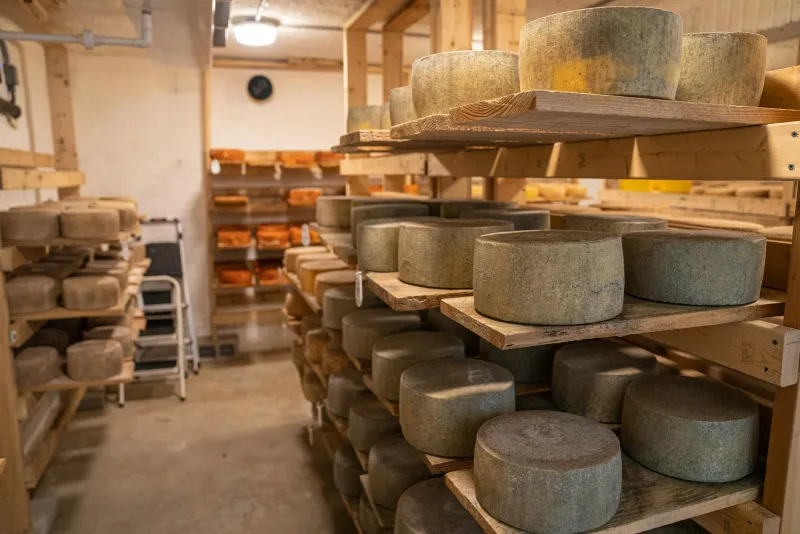
Deep beneath the rolling hills of Missouri, in a network of limestone caves that stretch for hundreds of miles, the United States government once operated the world's largest cheese warehouse. For over a decade, these subterranean chambers held more than a billion pounds of processed American cheese—enough to make a grilled cheese sandwich for every person on Earth, with leftovers.
This wasn't some Cold War-era survival bunker or strategic food reserve. It was the accidental result of a farm support program that got so spectacularly out of hand that federal officials spent years trying to figure out how to give away mountains of dairy products before they spoiled. The story of America's "Government Cheese" program reads like economic policy written by Franz Kafka.
How Good Intentions Created a Dairy Disaster
The cheese catastrophe began in 1977 with the best of intentions. American dairy farmers were struggling with volatile milk prices and foreign competition. To stabilize the industry, Congress created the Commodity Credit Corporation's dairy price support program, which guaranteed farmers a minimum price for their milk by having the government purchase any surplus production.
The logic seemed sound: if market prices fell below the federal support level, the government would step in as a buyer of last resort, keeping dairy farms solvent while building a strategic food reserve. What lawmakers didn't anticipate was just how much surplus milk American farms could produce when they had a guaranteed customer.
"Nobody ran the numbers on what happens when you remove price signals from a market," explained agricultural economist Dr. Sarah Chen, who studied the program's effects. "Farmers responded to guaranteed prices exactly as you'd expect—they produced as much as physically possible."
The Exponential Growth of Dairy Madness
Within two years, the government was purchasing 432 million pounds of cheese annually. By 1981, that figure had exploded to nearly 560 million pounds. The Department of Agriculture, designed to handle modest commodity surpluses, suddenly found itself managing a dairy empire that rivaled major food corporations.
 Photo: Department of Agriculture, via logowiki.net
The cheese had to go somewhere, and traditional warehouses couldn't handle the volume or provide the climate control needed for long-term storage. That's when federal officials discovered the limestone caves beneath Springfield, Missouri—natural refrigerators with consistent 58-degree temperatures and low humidity that made them perfect for cheese aging.
 Photo: Springfield, Missouri, via blogger.googleusercontent.com
"We went from storing a few million pounds in regular warehouses to managing what was essentially an underground city of cheese," recalled former USDA administrator Robert Morrison. "The caves were so vast that workers used golf carts to navigate between storage areas."
The Secret Cheese Mountains
By 1983, the Missouri caves contained over 700 million pounds of cheese, stacked in blocks the size of small cars and arranged in formations that stretched beyond the reach of industrial lighting. The operation employed hundreds of workers and required specialized equipment to move and monitor the massive inventory.
The government tried to keep the scale of the stockpile quiet, fearing it would become a political embarrassment. Internal USDA memos from the period, obtained through Freedom of Information Act requests, reveal officials scrambling to find ways to reduce the surplus without flooding the commercial cheese market.
"We were basically running a socialist cheese empire in the middle of Missouri," one anonymous memo noted. "Every month we're adding more cheese than some countries produce in a year, and we have no idea what to do with it."
The Bureaucratic Nightmare of Cheese Management
Managing a billion pounds of cheese created logistical challenges that no government agency was prepared to handle. The Department of Agriculture had to develop entirely new protocols for inventory tracking, quality control, and rotation schedules to prevent spoilage.
Workers in the caves reported surreal working conditions. "You'd walk through these tunnels and see cheese walls stretching farther than you could see," remembered cave supervisor Linda Rodriguez. "We had maps like you'd use in a mine, marking different sections: 'Cheddar Canyon,' 'Swiss Valley,' 'Processed Plateau.' It was like a dairy theme park underground."
The cheese required constant monitoring for temperature, humidity, and signs of spoilage. Federal inspectors made regular rounds through the caves, testing samples and documenting the condition of blocks that might sit in storage for years. Some wheels of cheese were moved dozens of times as workers tried to optimize storage configurations.
The Political Pressure Cooker
By 1981, the cheese stockpile had become a $4 billion liability on the federal balance sheet. The Reagan administration, committed to reducing government spending, found itself owning more dairy products than many countries produced annually.
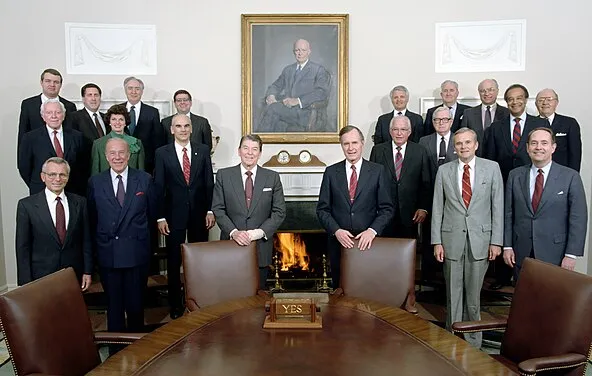 Photo: Reagan administration, via upload.wikimedia.org
The political optics were devastating. While the administration preached fiscal responsibility and free-market principles, it was simultaneously operating the world's largest cheese monopoly. Critics dubbed it "Reagan's Cheese Mountains" and used the stockpile as evidence of government incompetence.
"We had conservatives arguing for smaller government while managing a billion-pound cheese warehouse," noted political historian Dr. James Patterson. "The irony was too perfect for Democrats to ignore."
The Great Cheese Giveaway
Desperate to reduce the surplus, the Reagan administration launched an unprecedented food distribution program in 1982. The government began giving away 30-pound blocks of processed cheese to food banks, schools, and low-income families through a program officially called "Temporary Emergency Food Assistance."
The cheese distribution became a defining image of 1980s America. Television news regularly featured footage of long lines of families waiting to receive their monthly government cheese allocation. The distinctive processed flavor and bright orange color of the surplus cheese became embedded in American cultural memory.
"Government cheese had a very specific taste," recalled Maria Santos, who received distributions as a child in Detroit. "It was different from store-bought cheese—more processed, saltier. But when your family was struggling, it was a blessing. That cheese probably fed my family for two years."
The Slow Melt Down
It took nearly a decade to work through the cheese mountain. The government expanded distribution programs, sold cheese at steep discounts to food processors, and even experimented with exporting surplus dairy products as foreign aid. By 1990, the caves were finally empty, and the dairy price support program had been reformed to prevent similar accumulations.
The total cost of the cheese stockpile exceeded $8 billion when accounting for storage, handling, and distribution expenses. Agricultural economists estimate that the program cost taxpayers more than twice what it would have cost to simply pay farmers direct subsidies without purchasing their surplus production.
The Legacy of America's Cheese Empire
The Government Cheese program became a cautionary tale about unintended consequences in agricultural policy. It demonstrated how well-intentioned market interventions could spiral into absurd bureaucratic enterprises that served no one well—not farmers, not consumers, not taxpayers.
The Missouri caves still exist, though they now house more conventional storage operations for private companies. Occasionally, urban explorers report finding forgotten blocks of government cheese in remote corners of the tunnels, preserved by the cool, dry air like dairy fossils from America's strangest economic experiment.
"The cheese caves became a perfect metaphor for government overreach," reflected policy analyst Dr. Patricia Williams. "It's the kind of story that sounds too absurd to be true, but it happened because nobody asked the obvious question: what happens when the government becomes the biggest cheese buyer in history?"
Today, agricultural economists still study the Government Cheese program as an example of how market distortions can create unintended consequences that dwarf the original problem they were meant to solve. The billion-pound cheese stockpile remains one of the most expensive lessons in economic policy ever conducted—and proof that sometimes the cure really can be worse than the disease.