Nobody Owns the Middle: The International Bridge Where Two Countries Draw the Line — Then Stop

Photo by Photo by CHUTTERSNAP on Unsplash on Unsplash
Most bridges have a pretty simple origin story. Someone needed to cross something. Someone else paid for it. Done. But scattered across the world's more complicated border regions, there are a handful of crossings where that clean narrative falls apart completely — and one of the most striking examples sits on a boundary that two governments have spent decades pretending isn't their problem.
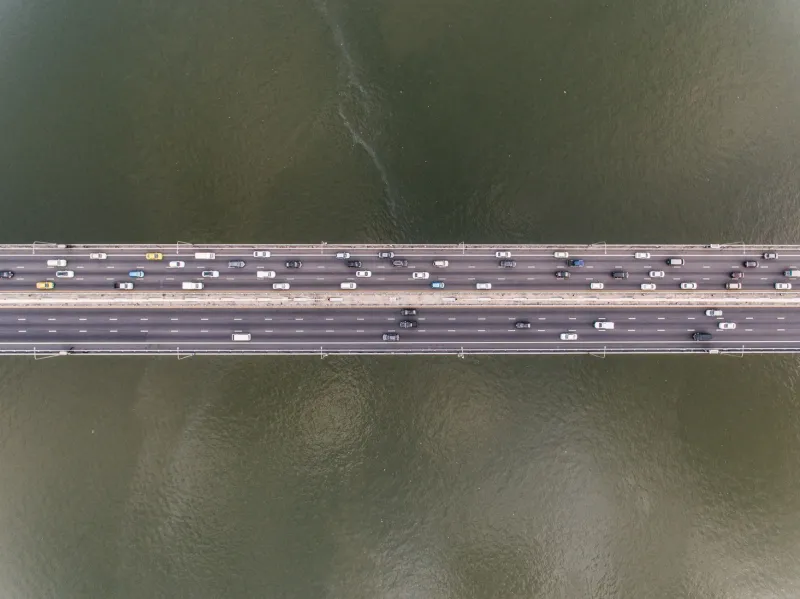
The bridge in question spans a river that also happens to mark an international border. On paper, that sounds manageable. In practice, it has created a bureaucratic no-man's land that neither country has been willing to fully claim, fully fund, or fully govern — for going on half a century.
How a River Became a Loophole
When the original treaty establishing this crossing was drafted, the boundary line was drawn straight down the center of the river below. That's a common enough approach in international border-making — rivers are convenient, visible, and hard to argue with. The problem is that rivers move. Channels shift. Sediment builds up on one bank and erodes on the other. Over time, the physical center of the river and the legal center of the border started quietly drifting apart.
The bridge, built by a private consortium in the mid-twentieth century, was designed to span both banks with a midpoint that — at the time of construction — sat neatly on the treaty line. The consortium eventually dissolved. The bridge didn't. And the question of who inherited responsibility for it turned into one of those diplomatic loose ends that both governments quietly agreed to never quite tie up.
Each country claimed ownership of its respective half. Each country maintains its own inspection crews, its own approach roads, its own border checkpoint. But the middle section — roughly forty feet of steel and concrete sitting directly over the contested channel — exists in a jurisdiction that neither nation has formally accepted.
The Toll Booth That Operates in Legal Imagination
Here's where it gets genuinely strange. The bridge collects tolls. It has for decades. Depending on which direction you're crossing, you pay at one booth or the other, operated by whichever country's infrastructure authority happens to be running that side. The revenue goes into national coffers. The maintenance budget, theoretically, is split according to a memorandum of understanding that was last formally updated in the 1980s and has never been ratified as a binding treaty by either legislature.
That memorandum — a document that both countries treat as gospel when it's convenient and quietly ignore when it isn't — assigns maintenance responsibility based on a zoning system that divides the bridge into thirds. Each country handles its outer third. The middle third is assigned to a joint committee that has not formally convened in over fifteen years.
The joint committee technically still exists. It has a name, a charter, and a mailing address. It does not appear to have a current membership roster.
When Something Breaks in the Middle
For most of the bridge's operational life, this arrangement has worked well enough because nothing catastrophic has happened in that center section. Routine wear gets handled informally — one country's crew will patch something, bill the other country, receive no response, and eventually absorb the cost. It's a system built entirely on mutual inaction and low-grade institutional amnesia.
Engineers who have inspected the structure note that this informal patchwork has actually kept the bridge in reasonable condition, largely because both countries have strong economic incentives to keep it open. Thousands of vehicles cross it every day. Commerce depends on it. Closing it over a jurisdictional dispute would be politically embarrassing for everyone involved.
But legal scholars who have studied the crossing point out that the current arrangement is only stable as long as nothing serious goes wrong. If a structural failure were to occur in that unclaimed middle section, the question of liability — who gets sued, under which country's laws, in which court — would be genuinely unresolved. Both nations' legal systems would have a credible argument for jurisdiction. Both would also have a credible argument for why the other one should pay.
The Treaty That Never Got Updated
The original boundary agreement between the two countries dates to an era when the idea of a bridge at this location was barely theoretical. The drafters were thinking about river navigation rights and fishing access, not about steel superstructures and tort liability. When the bridge was built, both governments issued letters acknowledging its existence and expressing general support for its operation. Neither issued anything that could be called a formal ownership agreement.
Attempts to revisit the question have stalled repeatedly — not because either country is hostile to resolving it, but because resolving it requires one or both governments to accept costs and responsibilities they've so far managed to avoid. Every few years, a diplomat or a transportation ministry official floats the idea of a new joint agreement. It gets tabled. The bridge keeps standing. The trucks keep crossing. The middle section keeps belonging to nobody.
Why This Is Stranger Than It Sounds
It's tempting to dismiss this as a minor bureaucratic oddity — two governments splitting hairs over a few dozen feet of bridge deck. But the implications ripple outward in ways that are quietly significant. Emergency services, for instance, operate under a gentlemen's agreement about which country's responders handle incidents in which sections. That agreement has never been tested by a serious accident. Customs enforcement in the center of the span technically falls under neither country's authority, a fact that has occasionally been exploited by people who understood the geography better than the border agents did.
The bridge is, in every practical sense, a functioning piece of infrastructure. It does what bridges are supposed to do. But underneath that functional surface is a legal structure — or rather, the absence of one — that turns every crossing into a small act of faith that the ambiguity won't suddenly matter.
Somewhere out there, in a filing cabinet in a government building in one of two countries, there is probably a memo about this. There is probably a recommendation. There is probably a note at the bottom that says awaiting further review.
It has been awaiting further review for a very long time.